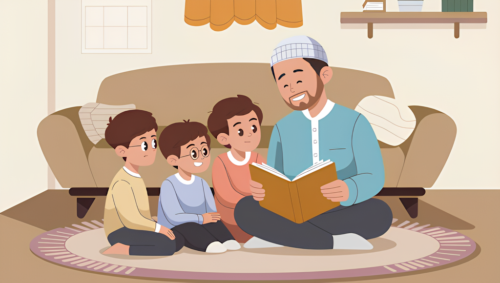
Children are among the greatest blessings granted by Allah. In Islam, nurturing children with love, discipline and righteous values is not just a responsibility, but a sacred trust and an Amanah from Allah which has been entrusted top every parent. Islamic parenting means not just fulfilling your children’s physical needs but also guiding them spiritually, emotionally and morally according to the Quran and Sunnah. When a child is nurtured according to these divine teachings, children become a source of mercy and lasting success for their parents in both this world and the hereafter.
The Islamic parenting in the modern world blends the core Quranic values with the contemporary challenges, focusing on spiritual, moral and character development along with balancing the worldly needs such as using the technology wisely, and modeling the prophetic gentleness, patience and accountability all rooted in compassion and strong faith.
Islamic Parenting Tips
Raising children according to Islam in today’s modern world is a challenge. In today’s day and age, children are surrounded by distractions and non-Islamic influences. Along with giving your children the teachings of Islam, you must also make your children experience the holy pilgrimage of Umrah. Children and humans in general learn more efficiently through the experiences rather than the textbook version of something. If you are looking forward to performing Umrah with your family, then Umrah packages from UK could be your biggest savior. The following guide shows you the steps that one can take to raise their children in an Islamic and balanced way.
Teaching through actions, not just words
Children generally imitate what they see, not what they are told. Parents are their first role models and their actions leave a lasting impression on the heart and mind of their children. If one really wants their children to grow up with strong Islamic values, they must start by embodying those values yourself. You must create an Islamic environment at home and demonstrate good character in daily life, and let your own actions reflect the teachings of the Quran and Sunnah.
Make Salah a family habit
Salah is the pillar of Islam and the clear distinction between a Muslim and a non-believer. The prophet (PBUH) advised the parents to teach their children prayer from an early age and encourage them to establish the habit of praying five times a day. To achieve this, parents should make Salah a family practice by praying together at home or in the mosque. When children witness their parents standing in prayer with devotion, they will naturally learn that Salah is not a burden but a blessing a a source of peace.
Emphasize on learning Quran from childhood
The Quran is the final and most complete book of Allah. It is revealed as the guidance for all aspects of life. It guides us about both spiritual and worldly matters. Without learning and understanding the holy Quran, one cannot become a true practicing Muslim. For this reason, parents should introduce their children to the Quran from an early age. Enrolling your children in Madaris or arranging proper Quran classes helps children not only recite it correctly but also understand its teachings. This will shape their character and guide them throughout life.
Parents must put emphasis on all the other pillars of Islam that includes fasting, charity work and the holy pilgrimage of Hajj. Parents can also make their children experience the minor pilgrimage of Umrah to give an up-close vision of the religion Islam and its practices. If you are planning to perform Umrah this year, you can opt for the Easter Umrah packages, offered by the Islamic travel, which is the most trusted name in the UK.
Teach daily duas and dhikr
Parents should make duas and dhikr a regular part of their children’s daily routine. You must teach them simple and basic duas, such as the duas before and after eating, the dua for drinking water, the dua before sleeping and the dua upon waking up. When children practice these duas regularly, they remain connected to Allah throughout the day. This constant remembrance brings blessings into their lives and helps them grow closer to Allah.
Create a halal environment at home
The environment in which children grow up has the greatest influence on their personality and behavior. Parents must create an Islamic environment at home which will allow children to adopt good values naturally. This means replacing the harmful or non-Islamic content with beneficial Islamic content. Parents must encourage children to watch Islamic cartoons, read the stories of the Prophets, and explore various Islamic books. At the same time, parents must keep them away from music, inappropriate media and negative influences. A pure and halal environment will help children remain connected to their faith and develop a strong Islamic identity.
Teach them Good Manners and Akhlaq
A person’s greatest beauty is found in their akhlaq, character and manners. The character of children reflects the upbringing given by their parents. That is why parents must teach their children basic manners such as respecting elders, greeting others with salaam and saying Bismillah before starting any task. Parents should not only instruct their children but also practice these manners themselves so that children can learn through observation. Developing good manners and akhlaq from a young age helps children grow into respectful and responsible Muslims.
Treat children with respect and love
Parents should not treat their children only with authority, but also build a friendly relationship with them. You must speak to them kindly and guide them with love as well as make them feel valued and respected. If they make mistakes, avoid harsh punishment and constant scolding. Instead, you must explain their mistake gently and make them understand the consequences of wrong actions. When children are corrected with love and respect, they are more likely to listen and avoid repeating the same mistake. This nurturing approach strengthens trust and creates a positive bond between parents and children.
Conclusion
Raising children is not a task of one day and it requires consistent effort, patience and dedication. If parents keep these important points in mind and apply them, they will succeed in raising their children as good Muslims. Islamic parenting is not about forcing or harshness but rather Islam teaches love, compassion, and kindness in nurturing children. By combining g guidance with mercy, parents can shape their children into righteous Muslims who will bring goodness to both this world and the hereafter.
With the rise of social media, many negative influences have spread, and the internet now offers all kinds of content. Some of this content is beneficial but most of it is harmful for children. Parents must therefore remain alert by limiting their children’s screen time and monitor their online activities.